

The Day Everything Changed

It was a Tuesday morning when Sarah, a digital marketing manager at a leading e-commerce brand, opened her laptop to find an urgent email from her Australian client. “Our teen engagement has dropped 40% overnight. What’s happening?”
What Sarah didn’t realize yet was that she was witnessing the beginning of a global shift in digital marketing—one that would force every agency, including the best digital marketing agency in Gurgaon, to rethink their strategies from scratch.
The Australia social media ban had just gone live.
A Decision That Shocked the World
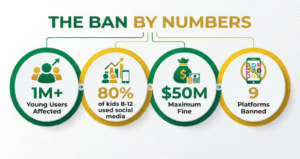
December 10, 2025, wasn’t just another day in the digital marketing calendar. It was the day Australia became the first country in the world to implement a complete social media ban for everyone under 16 years old. No exceptions. No loopholes.
Imagine waking up one morning to discover that over one million young users—nearly 80% of Australian kids aged 8 to 12—could no longer access TikTok, Instagram, Facebook, YouTube, Snapchat, X, Reddit, Threads, Twitch, or Kick. Their accounts? Gone. Their presence? Erased overnight.
For platforms that failed to comply, the penalty was staggering: up to $50 million in fines. This wasn’t a suggestion. It was law.
The Marketing Manager’s Nightmare

Let’s go back to Sarah. Her brand had spent months building a vibrant community of young fashion enthusiasts on Instagram. They had 50,000 followers in Australia alone, mostly teens who loved their quirky, affordable streetwear. Their engagement rates were through the roof, their conversion was solid, and their client was thrilled.
Until they weren’t.
Within 48 hours of the Australia social media ban taking effect, their Australian teen audience vanished. Comments stopped. Shares dropped to zero. The algorithm, no longer fed by engaged young users, started deprioritizing their content. Their carefully crafted strategy was falling apart.
Sarah called an emergency meeting. “We need to pivot,” she told her team. “And we need to do it now.”
This is the reality facing digital marketers worldwide. And if you think it’s just Australia’s problem, think again.
Why Australia Pulled the Trigger
The decision didn’t come from nowhere. For years, parents, educators, and mental health professionals had been sounding alarms about social media’s impact on young minds. Stories of cyberbullying, anxiety, depression, body image issues, and sleep deprivation flooded the news.
The Australian government listened. They looked at the statistics—more than a million kids under 16 actively using platforms designed for adults—and decided enough was enough. The mental health crisis among young people demanded action, even if that action was controversial.
Critics called it censorship. Supporters called it protection. But regardless of your stance, one thing was clear: the digital marketing world would never be the same.
The Ripple Effect Begins
Three weeks after the ban, marketing agencies across the globe started receiving the same questions from their clients:
“Could this happen in our country?”
“How do we reach young audiences now?”
“Is our current strategy at risk?”
As the best digital marketing agency in Gurgaon, we were fielding these questions too. Our international clients were nervous. Our local clients wanted to know if India was next. The truth? Nobody knows for sure, but the signs are there.
Malaysia started discussions about similar legislation. New Zealand expressed interest. European Union officials began drafting proposals. The Australia social media ban wasn’t an isolated incident—it was the first domino to fall.
A Day in the Life: After the Ban
Let me tell you about Lisa, a 15-year-old from Sydney who woke up on December 11 to find her Instagram account deactivated. No warning. No goodbye to her 2,000 followers. Just a message: “This account has been restricted due to age verification requirements.“
Lisa wasn’t a troublemaker. She used Instagram to share her artwork, connect with fellow young artists, and dream about becoming a designer one day. In one moment, that digital world disappeared.
Now multiply Lisa by one million. That’s how many young Australians lost their social media access overnight.
For marketers, this isn’t just about numbers on a dashboard. These are real people whose digital behavior has fundamentally changed.
The question is: Where did they go?
Where the Audience Went
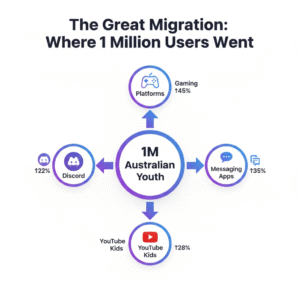
Here’s what we discovered while tracking the Australia social media ban’s aftermath:
Young people didn’t stop being online—they just went elsewhere. Messaging apps with parental controls saw a surge. Gaming platforms with social features gained traction. YouTube Kids alternatives experienced unprecedented growth. Discord servers for teens (with proper moderation) exploded in popularity.
The smart marketers—the ones who understood that every challenge is an opportunity—started following their audience to these new spaces. They adapted. They innovated. They survived.
The ones who didn’t? They watched their Australian market share crumble.
The Technology Race
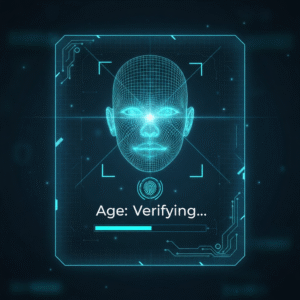
Behind the scenes, something fascinating was happening. Tech companies were scrambling to develop age verification systems that actually worked. Facial recognition AI trained to detect underage users. Document verification systems that could process IDs in seconds. Biometric authentication that balanced security with privacy.
The Australia social media ban didn’t just change marketing—it accelerated a technological revolution in identity verification. Within months, these systems would become standard across digital platforms worldwide.
For agencies like ours, recognized as the best digital marketing agency in Gurgaon, this meant adding a whole new skill set to our repertoire. Understanding age verification technology became as critical as understanding SEO or social media algorithms.
The Client Conversation
“We need to talk about Australia,” I told one of our major clients during a strategy review last week.
They looked confused. “We don’t even operate in Australia.”
“Not yet,” I explained. “But 15 countries are watching what happens there. If the Australia social media ban succeeds—or even if it partially succeeds—similar laws could appear in India, the US, Europe, and Southeast Asia within two years.”
Their face went pale. “So what do we do?”
That’s the question every brand should be asking right now.
Five Lessons from the Front Lines
After studying the Australia social media ban’s impact for three weeks and consulting with marketing experts globally, Here’s what we learned:
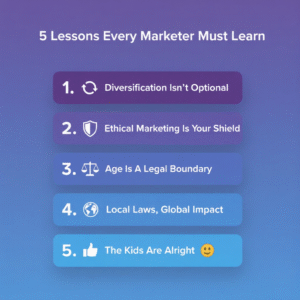
Lesson One: Diversification Isn’t Optional Anymore
Remember when everyone said “Don’t put all your eggs in one basket”? They were right. Brands that relied solely on Instagram or TikTok for youth engagement got devastated overnight. Those with presence across multiple channels—email marketing, content platforms, gaming communities, traditional media—weathered the storm.
Lesson Two: Ethical Marketing Is Your Shield
The ban exists because platforms failed to protect young users. Brands that proactively adopted ethical marketing practices—requiring parental consent, creating age-appropriate content, avoiding manipulative tactics—emerged with their reputations intact.
Those that pushed boundaries? They’re now facing public backlash.
Lesson Three: Age Isn’t Just a Number—It’s a Legal Boundary
We used to think of age as a demographic data point. Now it’s a compliance issue. Every campaign targeting families needs legal review. Every youth-focused strategy needs age verification planning. The cost of getting this wrong? Millions in fines and irreparable brand damage.
Lesson Four: Local Laws, Global Impact
The Australia social media ban proved that what happens in one country doesn’t stay in one country. A single nation’s policy can force global platforms to change their entire infrastructure.
As digital marketers, we need to think globally even when acting locally.
Lesson Five: The Kids Are Alright (But the Strategy Isn’t)
Young people adapted to the ban faster than brands did. They found new platforms, new communities, new ways to connect. The problem wasn’t the audience disappearing—it was marketers being too slow to follow.
What We’re Doing Differently Now
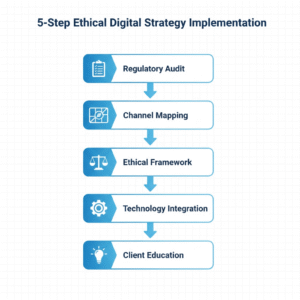
As the best digital marketing agency in Gurgaon, we’ve completely overhauled how we approach youth marketing strategies. Here’s our new playbook:
Step One: Regulatory Audit
Before launching any campaign, we map the regulatory landscape. Which countries have age restrictions? Which are considering them? What are the compliance requirements? We build strategies that work across multiple regulatory environments.
Step Two: Channel Mapping
We identify not just where our audience is today, but where they might be tomorrow if regulations change. For every primary channel, we develop two backup alternatives. If Instagram becomes restricted, do we have presence on age-appropriate platforms? If TikTok faces bans, can we pivot to YouTube or gaming communities?
Step Three: Ethical Framework
Every campaign passes through an ethics review.
Would we be comfortable explaining this strategy to a parent?
Does it respect young people’s cognitive development?
Does it prioritize wellbeing over engagement metrics?
If the answer to any question is “NO,” We redesign.
Step Four: Technology Integration
We’re investing in understanding and implementing age verification technologies. Our clients need partners who can navigate these systems, not fear them. We’re training our team on biometric authentication, AI-based age detection, and privacy-compliant verification methods.
Step Five: Client Education
The Australia social media ban taught us that clients need more than execution—they need understanding. We’re hosting workshops, creating educational content, and having honest conversations about risk. An informed client makes better decisions and builds more sustainable strategies.
The India Question
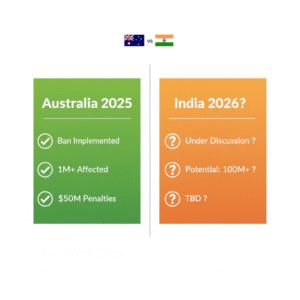
“Will India implement an Australia-style social media ban?”
I get asked this question three times a week. The honest answer?
I don’t know. But I know this: India has 600 million internet users, including millions of children.
The government has already shown willingness to regulate social media through IT rules and data protection laws.
Whether it’s a full ban like Australia or age-based restrictions with verification requirements, change is coming. The only question is when.
Smart agencies in India—those aspiring to be or already recognized as the best digital marketing agency in Gurgaon, Mumbai, Bangalore, or anywhere else—are preparing now.
They’re building flexible strategies, diversifying channels, and prioritizing compliance before it becomes mandatory.
The ones waiting for regulations to arrive before adapting?
They’ll be playing catch-up while their competitors lead the market.
A Glimpse into the Future
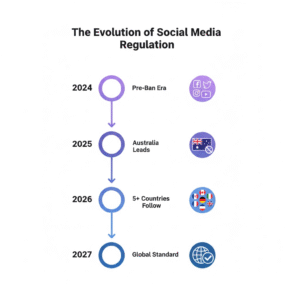
Let me paint you a picture of digital marketing in 2027:
Every social media platform has mandatory age verification at signup. AI systems scan profile pictures and behavior patterns to flag potential underage users. Parental consent is required for anyone under 18 to use advertising-supported platforms. Brands can’t target users under 16 with personalized ads, period.
Marketing to young audiences happens through dedicated kids’ platforms with strict content guidelines and parental controls. Gaming communities become primary youth marketing channels, but only with transparent sponsorships and age-appropriate messaging. Traditional media—TV, radio, print—sees a resurgence for family-oriented brands.
Agencies that adapted early? They’re thriving, commanding premium rates for their expertise in navigating this complex landscape. Those that resisted change? Many have closed their doors.
This isn’t science fiction. This is the trajectory we’re on, accelerated by the Australia social media ban.
The Human Side of Digital Marketing
Here’s what the Australia social media ban reminded me: behind every metric is a person. Behind every engagement rate is a child, a teenager, a young adult trying to figure out who they are.
For years, we’ve optimized for clicks and conversions, sometimes forgetting that we’re influencing real lives. The ban—controversial as it may be—forced us to pause and ask: what responsibility do we have to the people on the other side of the screen?
As marketers, we’re storytellers, persuaders, influencers. That power comes with responsibility. The Australia social media ban is a reminder that society is watching how we use that power, especially when it comes to young people.
The best digital marketing agency in Gurgaon isn’t just the one with the highest ROI or the flashiest campaigns. It’s the one that balances business objectives with ethical responsibility, that innovates while protecting vulnerable audiences, that leads with both head and heart.
Your Move
So where does this leave you?
If you’re a brand manager, start asking your agency tough questions. How are they preparing for potential regulatory changes? What’s their backup plan if your primary social channels become restricted? How do they approach youth marketing ethically?
If you’re an agency owner, audit your strategies now. Diversify your channel mix. Train your team on compliance and ethics. Build relationships with legal experts who understand digital marketing regulations.
If you’re a digital marketer, stay informed. Follow regulatory developments globally, not just locally. Learn about age verification technology. Develop expertise in alternative platforms. Position yourself as someone who can navigate this new landscape.
The Australia social media ban isn’t the end of youth marketing—it’s the beginning of youth marketing done right.
Conclusion: The Story Continues
Three months ago, Sarah—remember her?—thought her career was over. Her Australian client was furious, her strategy was in shambles, and she had no idea how to fix it.
Today, Sarah’s team is thriving. They rebuilt their strategy around gaming partnerships, YouTube content collaborations, and family-focused campaigns that engage parents and teens together. Their Australian client is happier than ever, their engagement is higher than before the ban, and they’re converting at record rates.
What changed? Sarah stopped seeing the Australia social media ban as a disaster and started seeing it as an opportunity. She adapted, learned, and led her team into new territory.
That’s the story of digital marketing in 2025 and beyond. Regulations will change. Platforms will rise and fall. But marketers who stay flexible, ethical, and informed will always find a way to connect brands with audiences.
The Australia social media ban is just the first chapter. The rest of the story? We’re writing it together, one campaign at a time.
Ready to future-proof your digital marketing strategy? As the best digital marketing agency in Gurgaon, we help brands navigate regulatory changes, diversify their channel mix, and build sustainable, ethical campaigns that deliver results. Contact us today to discuss how we can prepare your brand for the evolving digital landscape.