
Introduction: What Is Growth Marketing and Why It Matters Today
Traditional marketing focuses on brand awareness and getting your message in front of people. But awareness alone doesn’t pay the bills. In today’s competitive landscape, businesses need more than visibility—they need actual growth.
That’s where growth marketing comes in.
Growth marketing is about building systems that drive measurable results across the entire customer journey, from the first click to long-term loyalty. It’s not just about acquiring customers; It’s about keeping them, turning them into advocates, and maximizing their lifetime value.
Startups and modern businesses have adopted growth marketing because it’s accountable, data-driven, and focused on what truly matters: sustainable growth. Unlike traditional marketing campaigns that run their course and end, growth marketing is an ongoing process of testing, learning, and optimizing.
This approach evolved from the lean startup movement, where resources are limited and every dollar spent must be justified with results. Companies like Dropbox, Airbnb, and HubSpot didn’t just market their products—they engineered growth into everything they did.
Whether you’re a startup founder, a marketing professional, or a business owner looking to scale, understanding what is growth marketing can transform how you approach customer acquisition and retention.
What Is Growth Marketing? (The Core Definition)
So, what is growth marketing exactly?
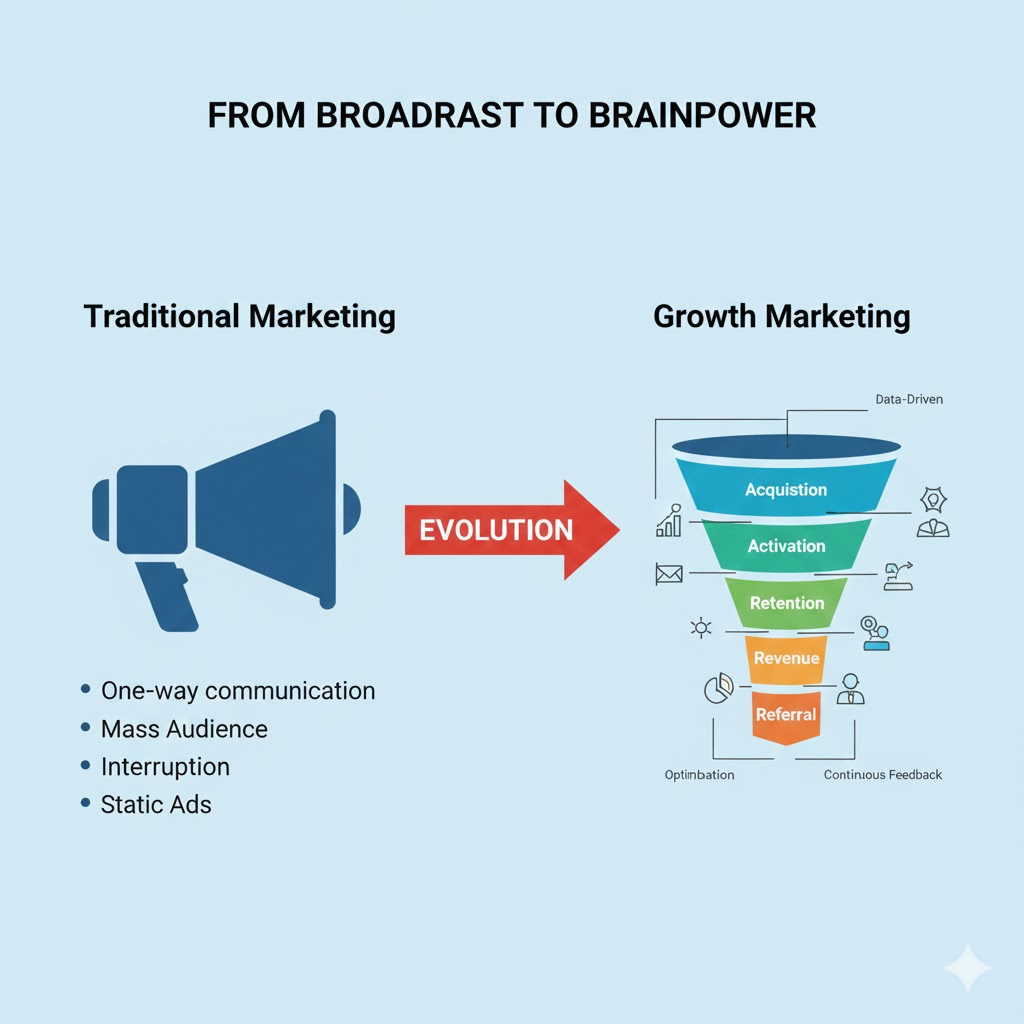
Growth marketing is a data-driven approach that focuses on the entire customer lifecycle—not just acquisition. It’s about experimenting across channels, analyzing what works, and scaling successful strategies while eliminating what doesn’t.
Unlike traditional marketing that might run a campaign and call it done, growth marketing operates on continuous testing and iteration. Every touchpoint is an opportunity to learn something new about your customers and improve their experience.
Here are the core principles:
Data-Driven Experimentation: Growth marketers don’t guess. They test hypotheses, measure results, and let data guide decisions. Whether it’s A/B testing email subject lines or experimenting with landing page designs, everything is measurable.
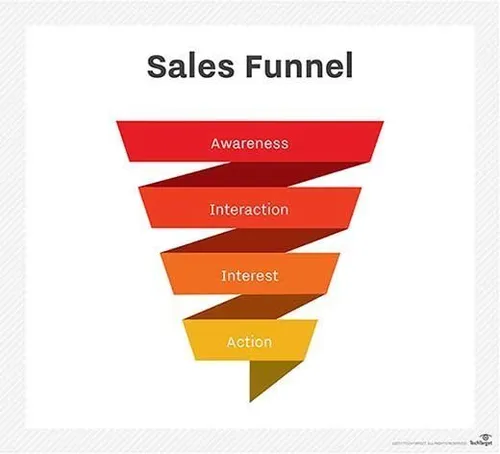
Full Funnel Focus: While traditional marketing often stops at awareness or acquisition, growth marketing optimizes every stage—from the moment someone discovers your brand to when they become a repeat customer and refer others.
Continuous Testing and Iteration: Growth marketing never stops. There’s always something to test, optimize, or improve. This mindset of constant experimentation leads to incremental gains that compound over time.
Long-Term Scalability: The goal isn’t just quick wins. Growth marketers build systems and processes that can scale as the business grows. They focus on sustainable strategies that work at both small and large volumes.
Think of growth marketing as treating your business like a product that needs constant improvement. Just as product teams iterate on features based on user feedback, growth marketers iterate on marketing strategies based on customer behavior.
For businesses working with a best digital marketing agency in Gurgaon or elsewhere, understanding this distinction helps you evaluate whether they’re truly growth-focused or just running traditional campaigns.
Growth Marketing vs Traditional Marketing
The difference between growth marketing and traditional marketing isn’t just semantic—it’s fundamental to how you approach business growth.
Campaign vs System Thinking
Traditional marketing thinks in campaigns: launch a campaign, run it for a set period, measure results at the end, and move to the next one. Growth marketing builds systems that continuously generate results. It’s not about isolated efforts but interconnected strategies that work together.
Vanity Metrics vs Actionable Metrics
Traditional marketing often celebrates metrics like impressions, reach, and brand awareness. While these have their place, they don’t directly correlate to revenue. Growth marketing focuses on actionable metrics: conversion rates, customer acquisition cost (CAC), lifetime value (LTV), retention rate, and revenue. These numbers directly impact your bottom line.
One-Time Execution vs Continuous Optimization
Traditional marketing executes a plan: create an ad, buy media space, run the campaign, and hope it works. Growth marketing treats every campaign as a test. Even successful campaigns are continuously optimized. There’s always room for improvement, whether it’s tweaking copy, adjusting targeting, or refining the offer.
Consider this example: A traditional marketer might spend $10,000 on Facebook ads, get 1,000 clicks, and call it a success. A growth marketer would analyze which ad variations performed best, what audience segments converted highest, where people dropped off, how many became customers, and what their lifetime value is. Then they’d reinvest in what worked and cut what didn’t.
This is why understanding search terms vs keywords becomes crucial in growth marketing—you’re not just bidding on keywords, you’re analyzing actual search behavior to optimize continuously.
The Growth Marketing Funnel (AARRR Framework Explained)
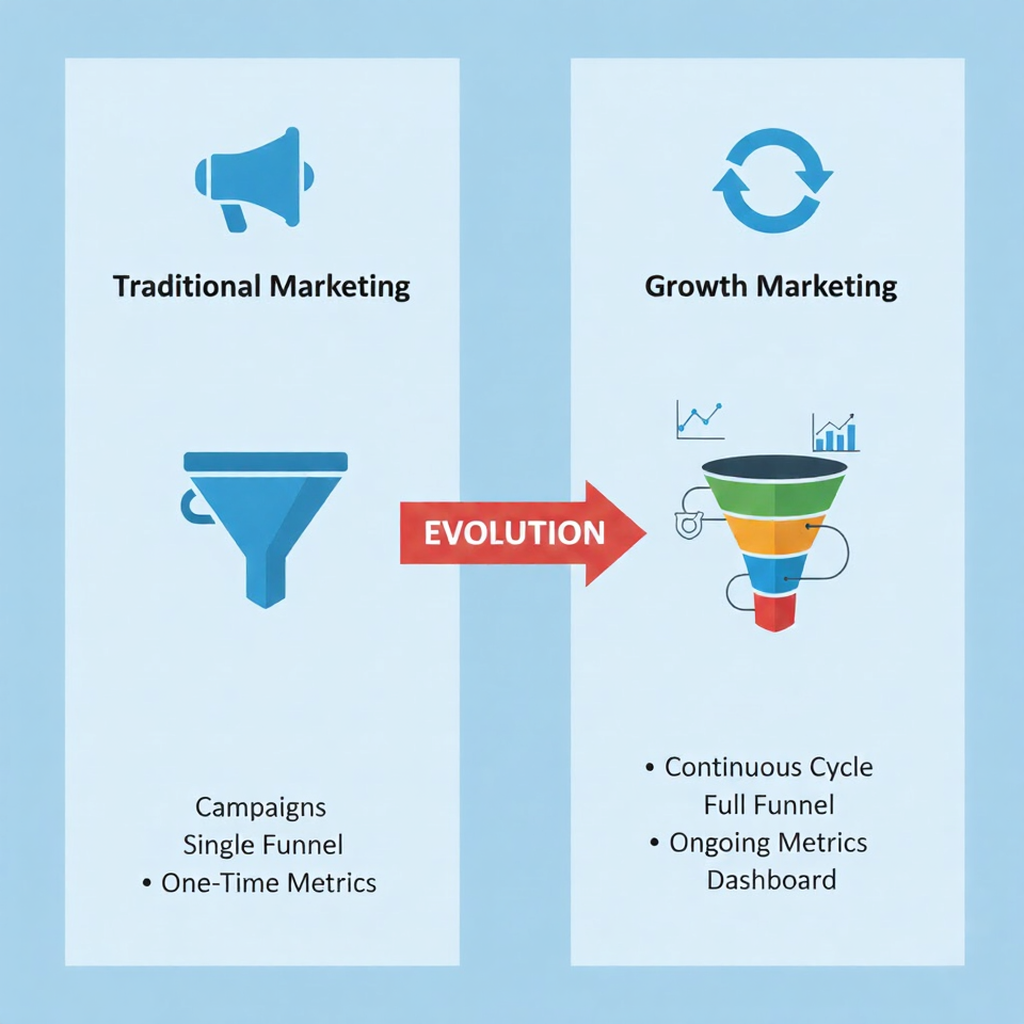
The AARRR framework, also called the Pirate Metrics (because it sounds like a pirate saying “AARRR!”), is the backbone of growth marketing. It breaks down the customer journey into five key stages that every growth marketer optimizes.
Acquisition: This is where potential customers first discover you. It could be through search engines, social media, paid ads, content marketing, or referrals. The key question: How are people finding you, and which channels bring the highest quality users?
Activation: Getting someone to visit your website isn’t enough. Activation happens when they have a positive first experience—signing up for your newsletter, creating an account, downloading a resource, or making their first purchase. The goal is to deliver value quickly so they understand why your product or service matters.
Retention: This is where many businesses fail. Retention is about keeping customers engaged and coming back. It’s much cheaper to retain an existing customer than acquire a new one. Growth marketers focus heavily on email marketing strategies, personalized content, and product improvements that keep people engaged.
Referral: Happy customers become your best marketers. The referral stage is about creating systems that encourage customers to tell others about you. This could be formal referral programs, social sharing features, or simply delivering such great experiences that people naturally recommend you.
Revenue: Finally, how do you increase the money each customer brings in? This involves upselling, cross-selling, optimizing pricing, introducing new products, or improving conversion rates at every touchpoint.
The beauty of the AARRR framework is that it shifts focus from just getting more people in the door to maximizing value from the people you already have. A 10% improvement in retention can have a bigger impact than a 10% increase in acquisition.
When working with agencies that claim to be the best digital marketing agency in Gurgaon or anywhere else, ask them how they approach each stage of this funnel. True growth marketing agencies don’t just focus on the top of the funnel.
Key Channels Used in Growth Marketing
Growth marketing isn’t about mastering one channel—it’s about orchestrating multiple channels that work together to drive results.
Content & SEO
Creating valuable content that ranks in search engines brings consistent, high-quality traffic. Unlike paid ads that stop when you stop paying, good content continues delivering results. Understanding what is search engine optimization forms the foundation of organic growth that compounds over time.
Paid Ads
When done strategically, paid advertising accelerates growth. The key is understanding that paid ads are not expensive, bad strategy is. Growth marketers use paid channels like Google Ads and Facebook ads for testing, learning what resonates, then scaling winners while cutting losers.
Email & Lifecycle Marketing
Email remains one of the highest ROI channels in digital marketing. Growth marketers use sophisticated campaigns that trigger based on user behavior, sending the right message at the right time. Discover 10 powerful reasons to use email marketing for building lasting customer relationships.
Social Media & Community
Social platforms aren’t just for broadcasting messages. They’re for building communities, engaging in conversations, and understanding what your audience cares about. Smart agencies know how to leverage what social media management actually does for sustainable growth.
Product-Led Growth
Your product itself becomes a marketing channel. Free trials, freemium models, and referral programs built into the product experience can drive exponential growth. Dropbox’s referral program is a classic example—both the referrer and the new user got extra storage space.
Partnerships & Referrals
Strategic partnerships with complementary businesses can open entirely new customer bases. Creating formal referral systems encourages your happy customers to become advocates.
The magic happens when these channels work together. Someone might discover you through SEO, engage with your social content, sign up through a paid ad, and become a loyal customer through email nurturing. Growth marketing orchestrates this entire journey.
Growth Marketing Strategies That Actually Work
Understanding growth marketing is one thing. Implementing strategies that drive real results is another. Here are proven approaches that successful growth marketers use.
Experimentation Mindset
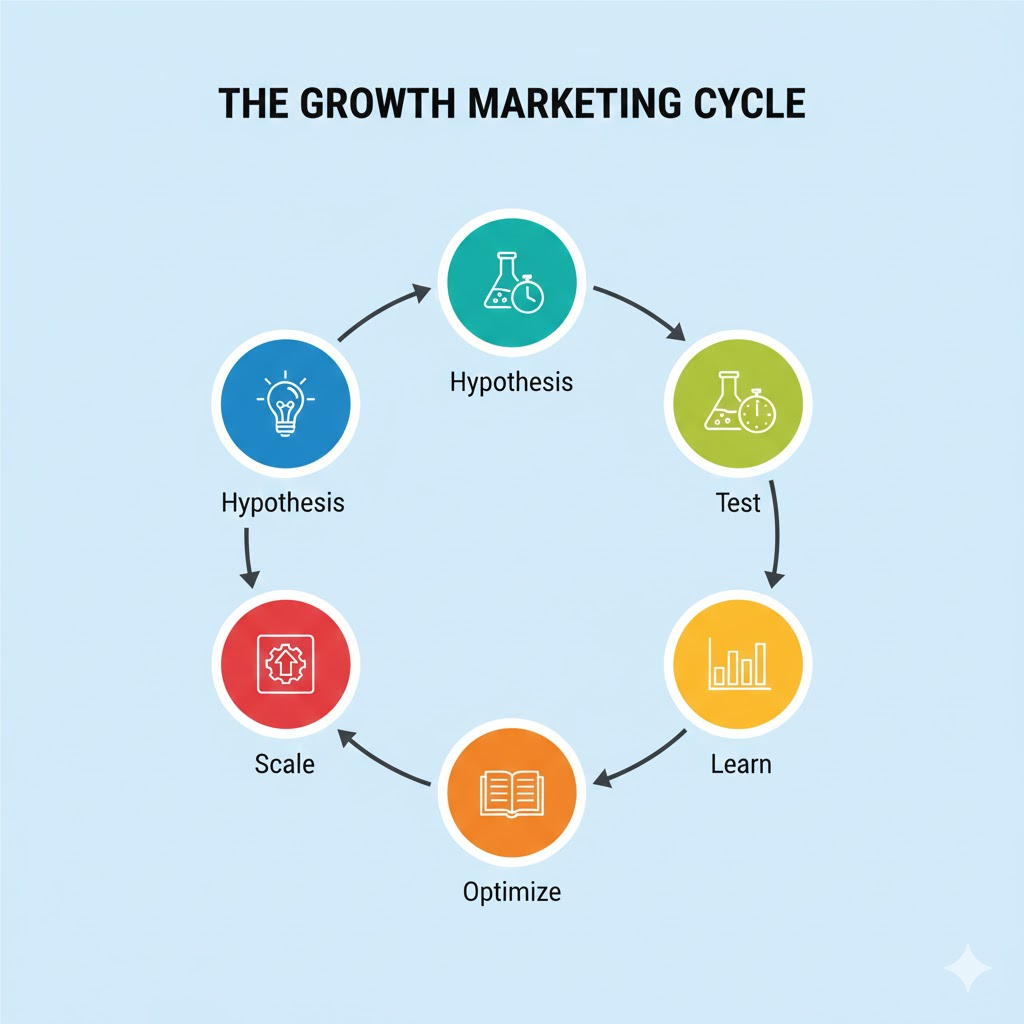
Treat everything as a hypothesis to be tested. Instead of saying “Let’s run this campaign,” say “We hypothesize that this message will resonate with this audience.” Then test it, measure results, and iterate. This scientific approach removes ego and emotion from decision-making.
Rapid Testing
Speed matters in growth marketing. The faster you can test ideas, the faster you learn what works. This doesn’t mean rushing or being careless—it means building systems that allow quick experimentation. Tools and processes that enable rapid testing give you a significant advantage.
Conversion Optimization
Small improvements compound dramatically. Increasing your conversion rate from 2% to 3% means 50% more customers from the same traffic. Growth marketers obsess over understanding customer buying behavior and removing friction at every step of the customer journey.
Retention-First Thinking
Most businesses focus too much on acquisition and not enough on keeping customers. Growth marketers flip this. They know that a 5% increase in customer retention can increase profits by 25-95%. Before spending more on acquiring new customers, optimize the experience for existing ones.
Leveraging Data and Feedback Loops
Create systems that collect data, analyze it, and feed insights back into strategy. This could be analytics platforms, customer surveys, user testing, or cohort analysis. The key is closing the loop—learning from data and actually changing your approach based on what you learn.
Building for Virality
Some products and campaigns naturally encourage sharing. Growth marketers intentionally design experiences that people want to tell others about. This isn’t manipulation—it’s creating genuine value that’s worth sharing.
These strategies work across industries, whether you’re a SaaS company, e-commerce brand, or service business. The key is consistent application and patience—growth marketing compounds over time.
Tools Used in Growth Marketing (Beginner to Advanced)
Tools don’t make you a growth marketer, but the right tools make growth marketing possible. Here’s how to think about growth marketing tools.
Analytics Tools: You can’t optimize what you don’t measure. Google Analytics tracks website behavior, while platforms like Mixpanel or Amplitude provide deeper product analytics. These tools answer questions like: Where do users come from? Where do they drop off? What actions correlate with retention?
Experimentation Tools: A/B testing platforms like Optimizely, VWO, or Google Optimize let you test different versions of pages, emails, or ads to see what performs better. These tools are essential for the continuous testing that defines growth marketing.
CRM and Automation: Customer relationship management systems like HubSpot, Salesforce, or ActiveCampaign help you track customer interactions and automate personalized communication. Marketing automation ensures the right message reaches the right person at the right time without manual effort.
SEO and Content Tools: Tools like SEMrush, Ahrefs, or Moz help with keyword research, competitive analysis, and tracking search rankings. Understanding tools that help with canonical tags and technical SEO ensures your content gets found.
Emerging AI Tools: In 2025, AI tools for e-commerce and marketing have become sophisticated. From content generation to predictive analytics, AI accelerates testing and personalization at scale. Understanding how to optimize content for AI search engines is becoming crucial as search evolves.
The tools you choose depend on your stage of growth. A startup might start with free tools like Google Analytics and Mailchimp, while a scaling company invests in comprehensive platforms. The key is not collecting tools but using them to drive decisions.
Remember, businesses often fail not because they lack tools but because they don’t use data to guide strategy. This is where partnering with experts who understand both tools and strategy, like a best digital marketing agency in Gurgaon, can accelerate your growth.
Common Growth Marketing Mistakes Businesses Make
Even with the best intentions, businesses make predictable mistakes when implementing growth marketing. Avoiding these pitfalls can save time, money, and frustration.
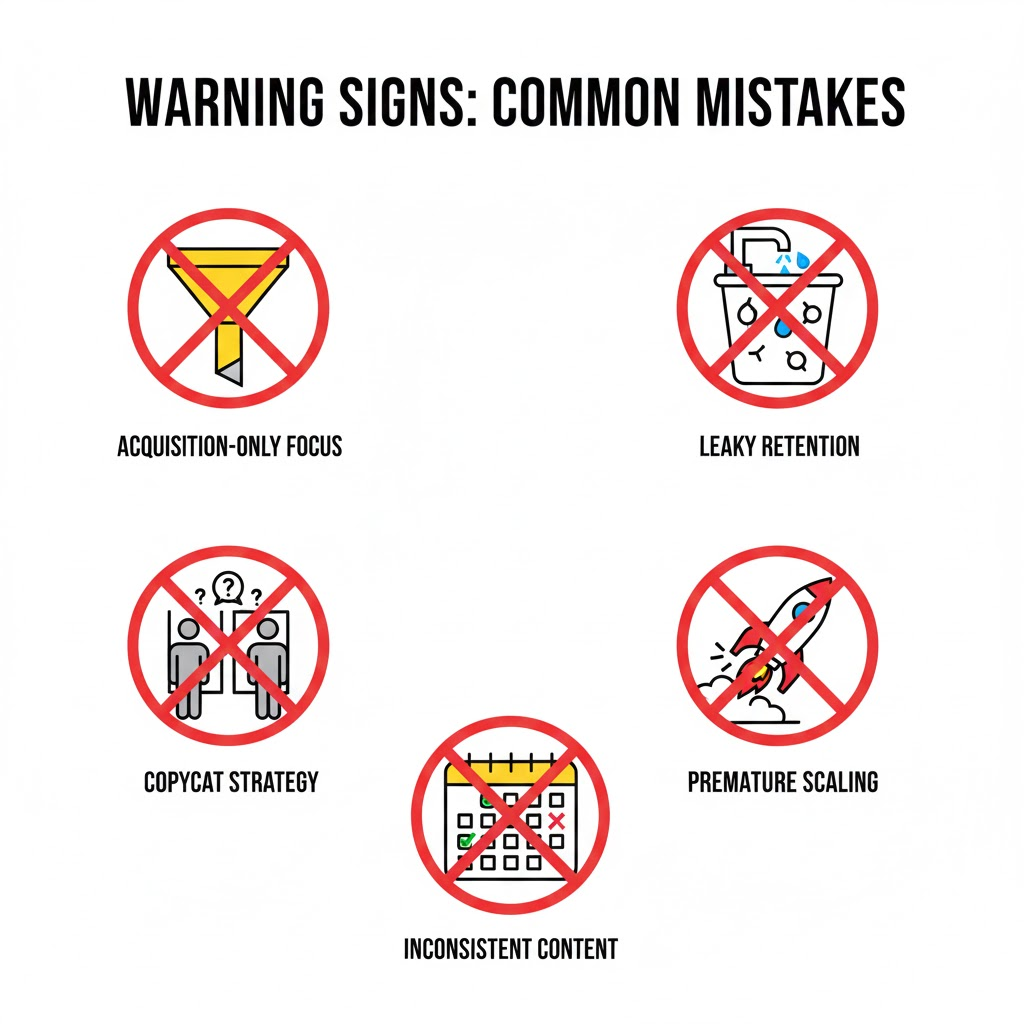
Focusing Only on Acquisition: The most common mistake is obsessing over getting new customers while ignoring existing ones. You’ve spent money and effort to acquire customers—don’t let them slip away due to poor onboarding, lack of engagement, or mediocre customer service. Understanding customer buying behavior helps you serve existing customers better.
Running Ads Without Retention: Pouring money into paid advertising while having a leaky bucket doesn’t work. If customers aren’t sticking around, fix retention before scaling acquisition. Otherwise, you’re just renting customers temporarily.
Copying Competitors Blindly: What works for one business may not work for yours. Your audience, positioning, and resources are different. Instead of copying, understand the principles behind competitors’ strategies and adapt them to your unique situation.
Scaling Before Validation: One of the biggest wastes of marketing budget is scaling something that barely works. Growth marketing is about finding what works small, proving it consistently, then scaling. Don’t 10x your ad spend until you’ve proven the unit economics work.
Ignoring Content Consistency: Growth compounds over time, but only if you’re consistent. Many businesses start strong then lose momentum. Whether it’s content marketing, email campaigns, or social media, consistency beats intensity.
Not Testing Enough: Conversely, some businesses test too little. They make assumptions about what customers want instead of letting data guide them. Growth marketing requires a culture of experimentation where testing is the norm, not the exception.
Vanity Over Value: Celebrating likes, followers, and page views feels good but doesn’t necessarily drive business results. Focus on metrics that matter: conversions, revenue, customer lifetime value, and retention rate.
Avoiding these mistakes often requires external perspective. This is one reason businesses partner with experienced agencies that understand what actually drives growth.
Who Should Use Growth Marketing?
Growth marketing isn’t just for tech startups or venture-backed companies. It’s valuable for any business that wants sustainable, measurable growth. Here’s who benefits most.
Startups: With limited resources and the need to prove traction quickly, startups benefit enormously from growth marketing’s focus on experimentation and efficiency. Every dollar must work harder, and growth marketing ensures accountability.
D2C Brands: Direct-to-consumer brands live and die by customer acquisition cost and lifetime value. Growth marketing’s emphasis on the full funnel—from awareness to advocacy—directly impacts profitability for D2C companies.
Service Businesses: Whether you’re a consulting firm, agency, or professional service provider, growth marketing principles help you build predictable client acquisition systems. Understanding how to introduce a new product in the market applies equally to new service offerings.
SaaS Companies: Software companies pioneered many growth marketing tactics because their business model demands it. Monthly recurring revenue requires both acquisition and retention excellence, which is exactly what growth marketing delivers.
Founders and Growth-Stage Teams: If you’re a founder wearing multiple hats or part of a lean team, growth marketing gives you a framework for prioritizing efforts. Instead of doing random marketing activities, you focus on systematic growth.
Even traditional businesses can adopt growth marketing principles. A local restaurant can use email marketing to drive repeat visits. A B2B manufacturer can use content marketing and SEO to generate leads consistently.
The question isn’t whether growth marketing applies to your business type—it’s whether you want measurable, sustainable growth. If the answer is yes, growth marketing is relevant.
Growth Marketing vs Performance Marketing
There’s often confusion between growth marketing and performance marketing. While they overlap, they’re not identical.
Performance marketing focuses on immediate, measurable results—typically acquisition and conversions. It’s campaign-based and often paid-channel-focused. When you hear “performance marketing,” think of running Google Ads or Facebook ads with clear ROI targets. The goal is efficient customer acquisition right now.
Growth marketing encompasses performance marketing but goes further. It includes acquisition but also activation, retention, referral, and revenue optimization. It’s systems-based rather than campaign-based. Growth marketing asks: “How do we build sustainable growth engines?” while performance marketing asks: “How do we get the most conversions for our budget this month?”
Think of it this way: performance marketing is a crucial component of growth marketing, but growth marketing is the bigger picture. You need both short-term ROI (performance marketing) and long-term growth systems (growth marketing) to build a sustainable business.
A Google Ads campaign strategy might be pure performance marketing if it’s focused only on immediate conversions. But when that campaign integrates with email nurturing, retention programs, and referral systems, it becomes part of a growth marketing approach.
Many agencies specialize in one or the other. When evaluating whether they’re the best digital marketing agency in Gurgaon or anywhere for your needs, clarify whether you need tactical campaign execution (performance marketing) or strategic growth systems (growth marketing).
Final Thoughts: Is Growth Marketing Right for Your Business?
After exploring growth marketing, from fundamentals to advanced strategies, you might wonder if it’s the right approach for your business.
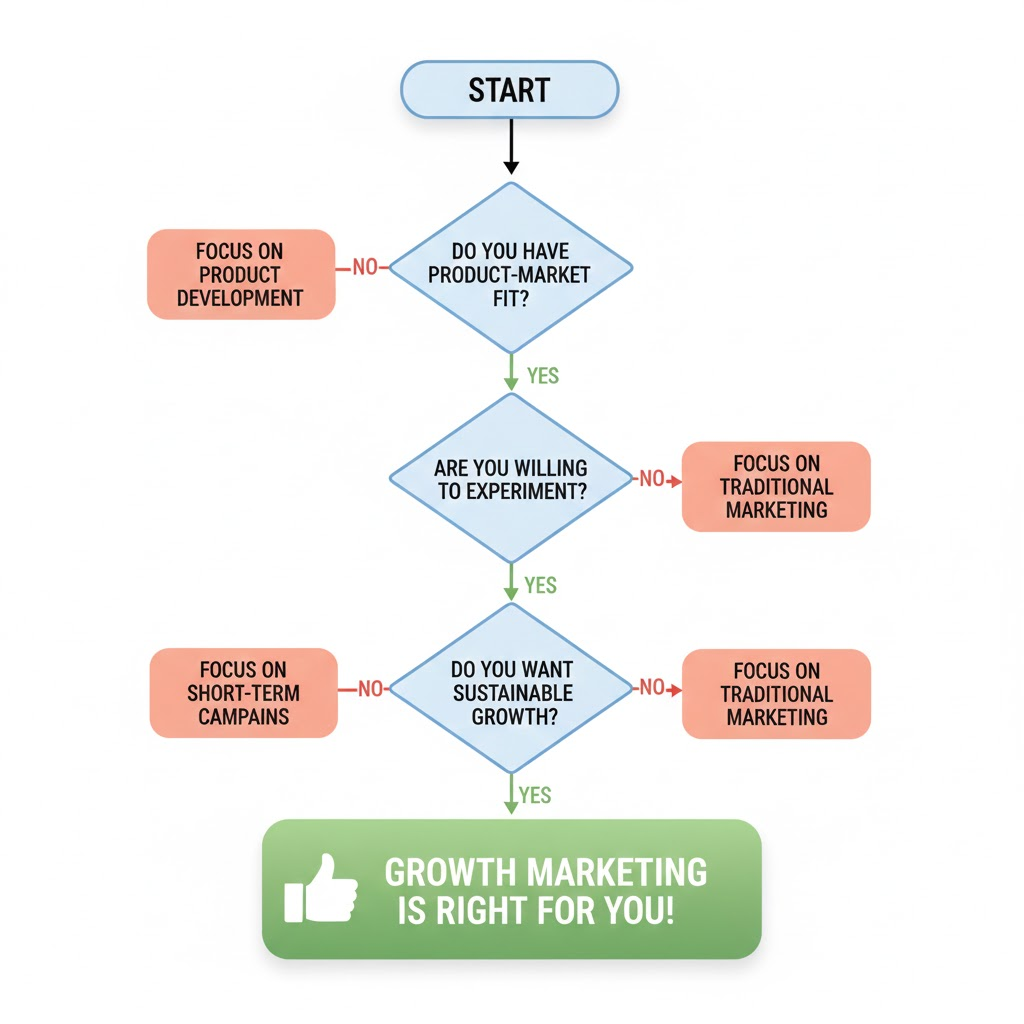
When growth marketing makes sense: If you have product-market fit or are close to it, growth marketing accelerates your trajectory. If you’re willing to experiment, learn from failures, and iterate based on data, growth marketing fits your mindset. If you want sustainable growth rather than temporary spikes, growth marketing delivers.
When it doesn’t: If you’re still figuring out your core value proposition, focus there first. Growth marketing optimizes and scales what already works—it doesn’t create product-market fit. If you want guaranteed outcomes immediately, growth marketing’s experimental nature might frustrate you. It requires patience for testing and learning.
The mindset matters more than tactics: Growth marketing is ultimately a way of thinking about business growth. It’s about curiosity, data-driven decision-making, customer focus across the entire journey, and continuous improvement. You can learn the tactics, but the mindset is what makes growth marketing stick.
As digital landscapes evolve with AI-powered search and new targeting models like The New Targeting Model in Google Ads, growth marketers adapt while staying true to core principles: test, learn, optimize, scale.
Whether you’re implementing growth marketing internally or partnering with experts, the key is starting. Begin with one stage of the funnel, implement testing systems, measure results, and iterate. Growth compounds over time—the sooner you start, the sooner you see results.
For businesses in competitive markets looking for strategic partners, finding the best digital marketing agency in Gurgaon or your local area means finding teams that think like growth marketers—data-driven, customer-focused, and committed to sustainable results, not just vanity metrics.
Remember: growth marketing isn’t about overnight success. It’s about building systems that deliver compounding returns over time. Start small, stay consistent, and let data guide your decisions. That’s how you win in the long run.